My persistent complainer has been Adam Elliott. He had asked me to write about the change in television content over the years. I blew him off again explaining that I would have to do too much reading before writing the post, but decided to tackle it tonight anyway.
Before we go any further, I want to make it clear that I greatly enjoy television. I don't watch a lot of it anymore because I just don't have the time, but I love Dexter, True Blood, The Walking Dead, and Sons of Anarchy when I do watch. Knowing this, hopefully as I start talking about this topic, I won't be considered a prude or sound self-righteous.
When television first came out in the 40's it was mainly used as a propaganda tool to get people to buy war bonds, telecast boxing matches and broadcast the news. Even the news was mainly a recap of the front page newspaper headlines. You didn't discover anything new on television that you couldn't read in that morning's paper. There was no discussion of the dangers of television content for almost twenty years, because there was nothing serious on television to discuss.
 |
| Technically, the Flinstones beat them by 2 years, but that was a cartoon. |
 Despite that huge leap, the following year I Dream of Jeannie debuts on television and the network decided that her showing her belly button would be too racy. In every episode, they either filled her navel with putty or had her wear a skin colored covering over it.
It was during this period (mid-60's) that the head of the FCC called television "wasteland TV," because it had become a bunch of silly nonsense. What had once been envisioned as a way of better bringing information to people was now showing The Beverly Hillbillies, The Munsters, The Addams Family, Bewitched, I Dream of Jeannie, My Mother the Car, Green Acres, and Gilligan's Island. As entertaining as they might have been, they were in no way depictions of the real world. For the first time, television was recognized as being an escape.
By the time day time talk shows came around, they focused on bringing the audiences attention to an issue or offering assistance (sometimes useful counseling) to their guests. Today, these shows are to do DNA tests to discover which of the dozen men someone has slept with might be the baby daddy or to celebrate some other family's unbelievable dysfunction. If the family is messed up enough, they might be given their own reality show.
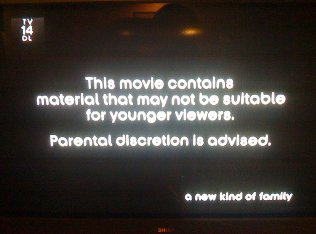 |
| If you call yourself a 'family' channel, should you really play this show? |
In 1951, I Love Lucy was almost cancelled before it even started because when it came time to film the pilot Lucille Ball was pregnant. The producers decided to go on with the show, but always keep her condition hidden from the camera. Years later, when she was carrying Desi, Jr. the network decided to incorporate her pregnancy into the show, but still forbid the use of the word 'pregnant.' Today, you can see outright sex acts on prime time network television. We are not shown full blown nudity, but very little is left to the imagination.
In 1967, the first curse word was used on television. Captain Kirk said, "Let's get the hell out of here" on Star Trek. Today, cursing is so common ABC has had two shows with the word 'bitch' in their titles.
- GCB - This stood for Good Christian Bitches, which they later changed to Good Christian Belles when it wasn't well received. Only a couple of episodes made it on screen. It was cancelled May 11, 2012.
- Don't Trust the B---- in Apt. 23 - The 'B' stands for bitch. This one is still on the air today in its second season.
Whether you have a problem with this evolution or not, the original point of my post was just to point out the changes. They have occurred and things have changed. Considering how far things have gone, we are left with the question that many have started asking.
Since so much is allowed and we show more and more all the time, should the FCC even be regulating or censoring television any more?
I would love to hear your thoughts.


.jpg)
.jpg&description=IS%20IT%20TOO%20SOON%3F%20-%20How%20soon%20is%20too%20soon%20to%20say%20I%20love%20you.%20One%20of%20my%20readers%20asked%20me%20when%20I%20knew%20that%20I%20was%20in%20love%20with%20my%20girlfriend.%20I%20tell%20my%20story%20and%20struggle%20with%20that%20question. "Pin It")

.jpg)